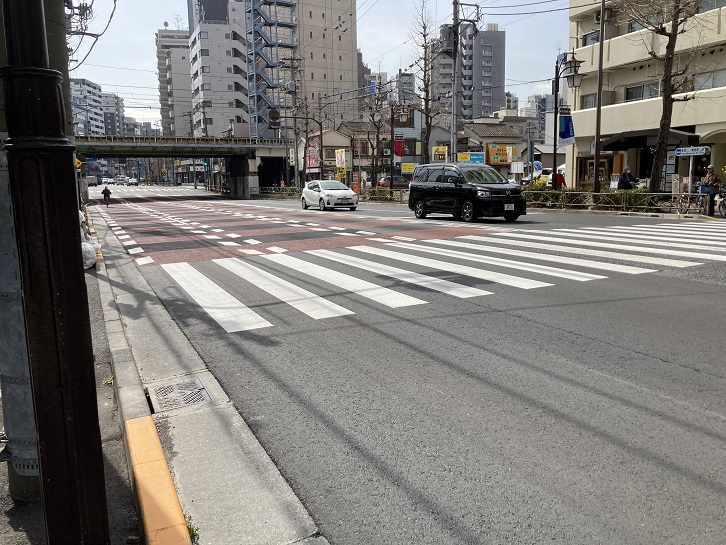
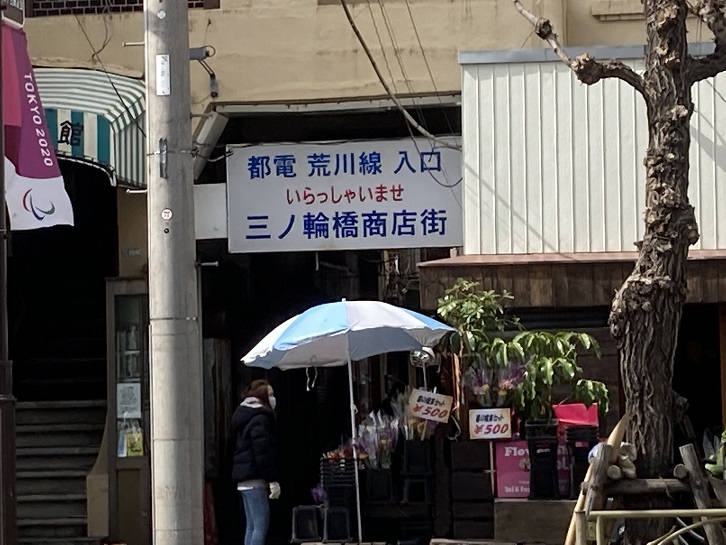
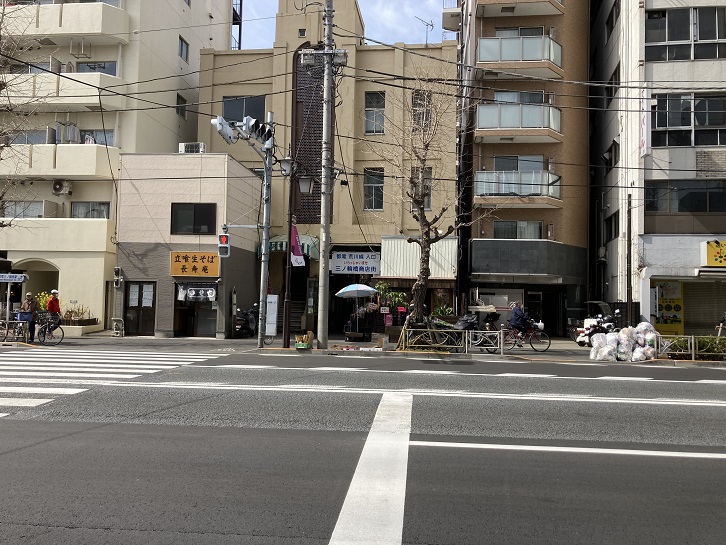
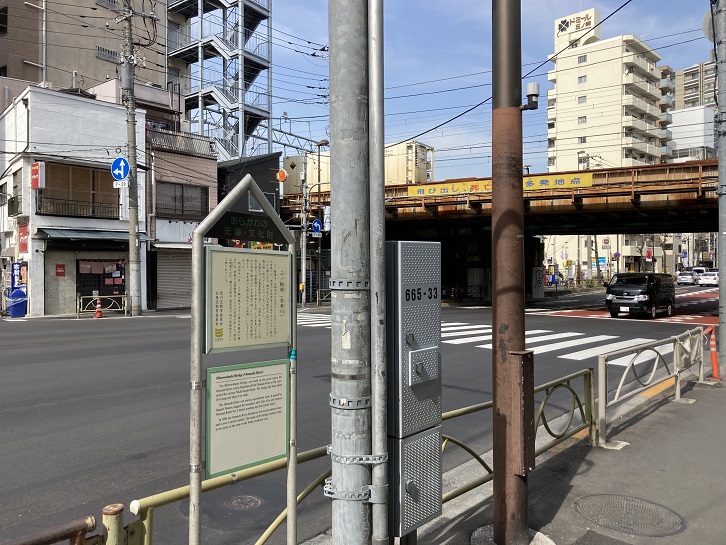
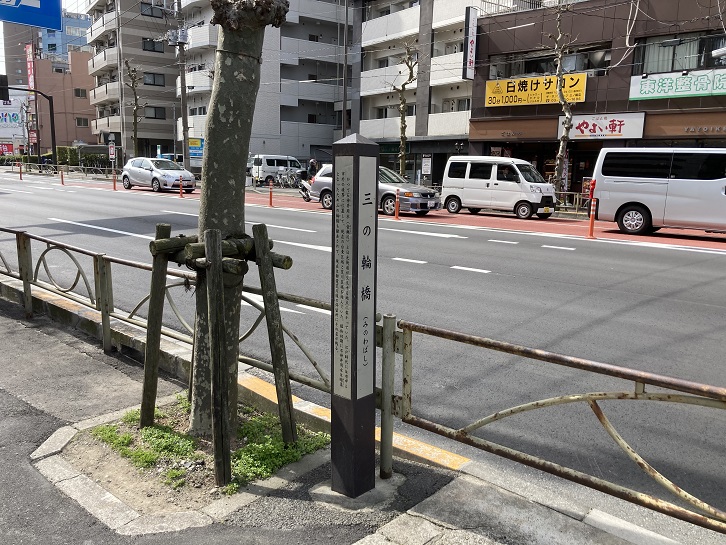
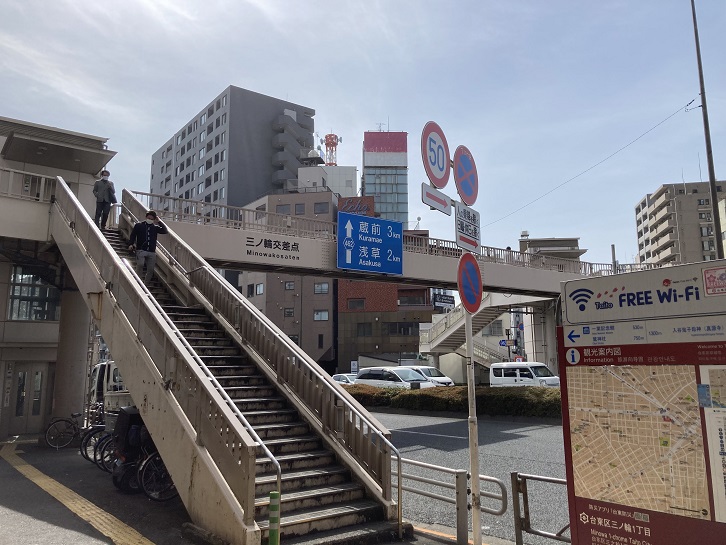
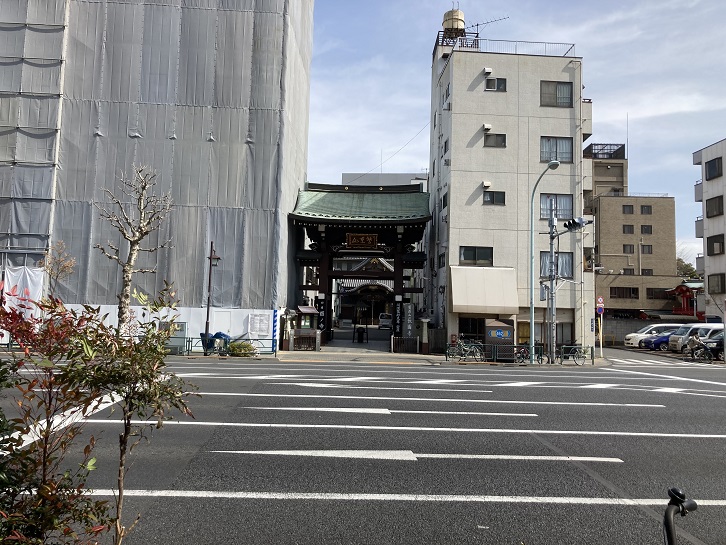
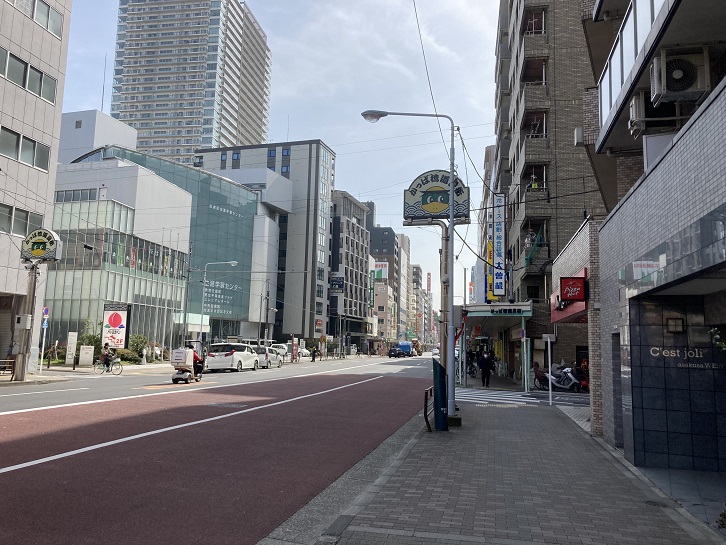
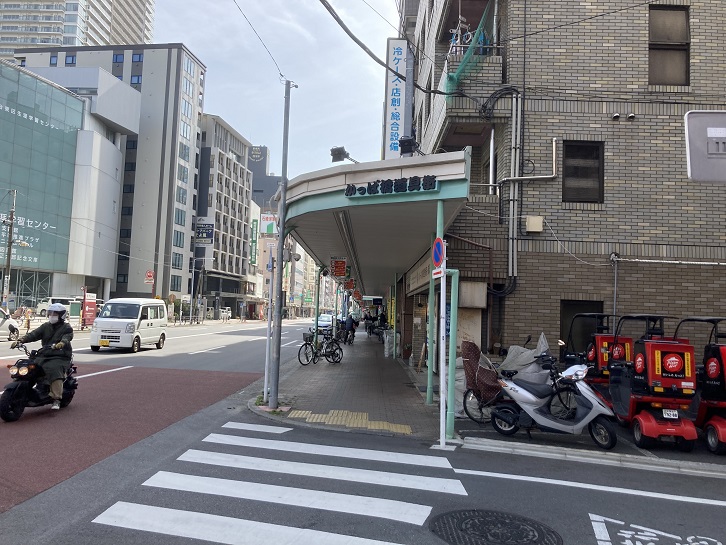
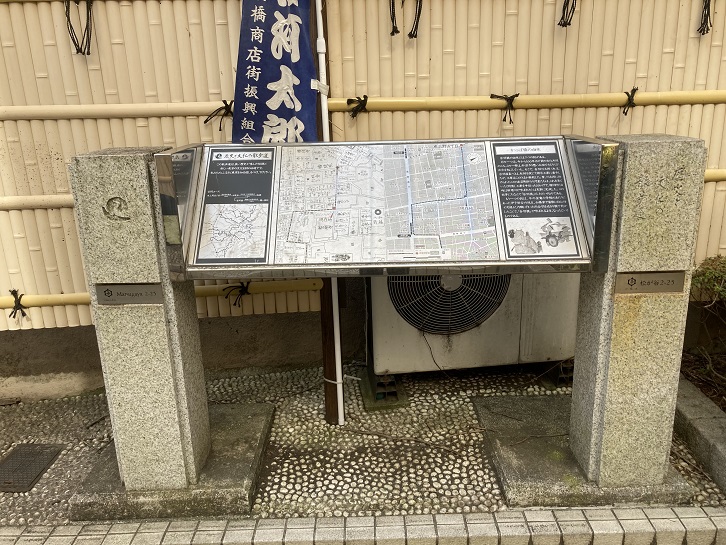
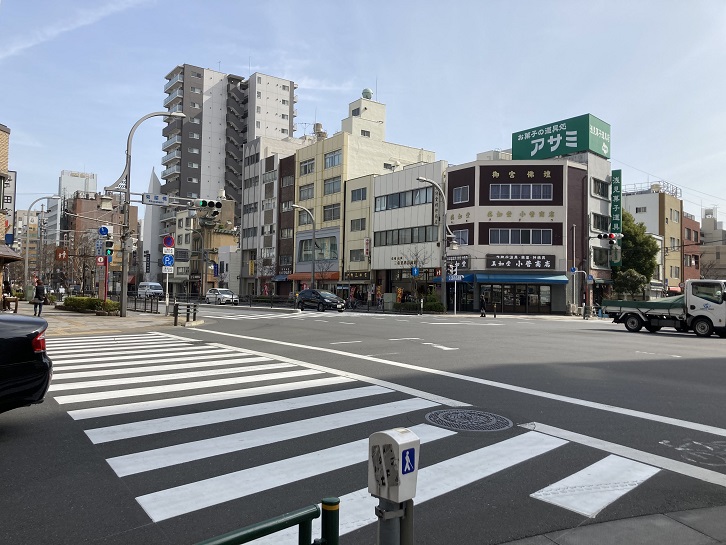
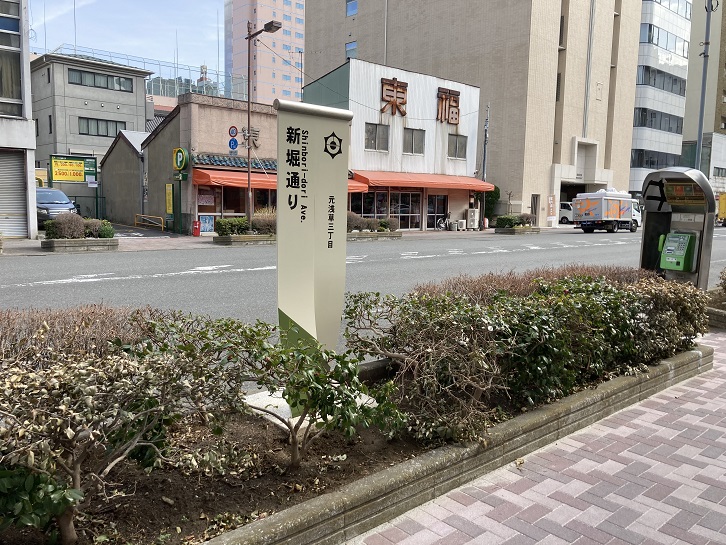
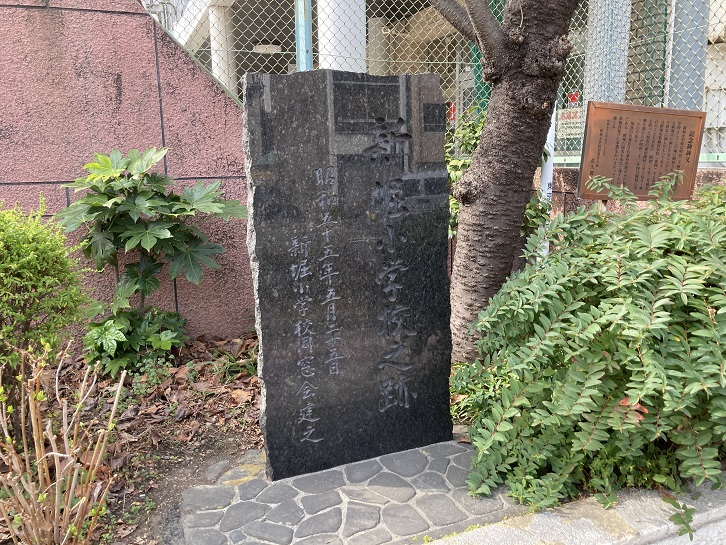
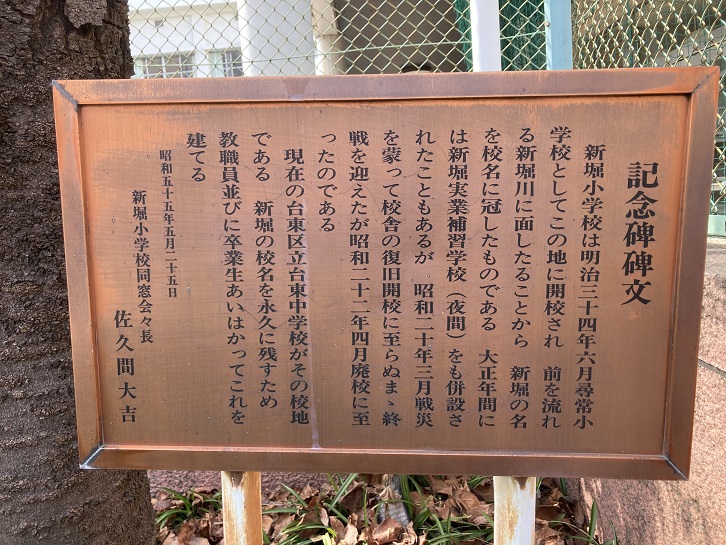
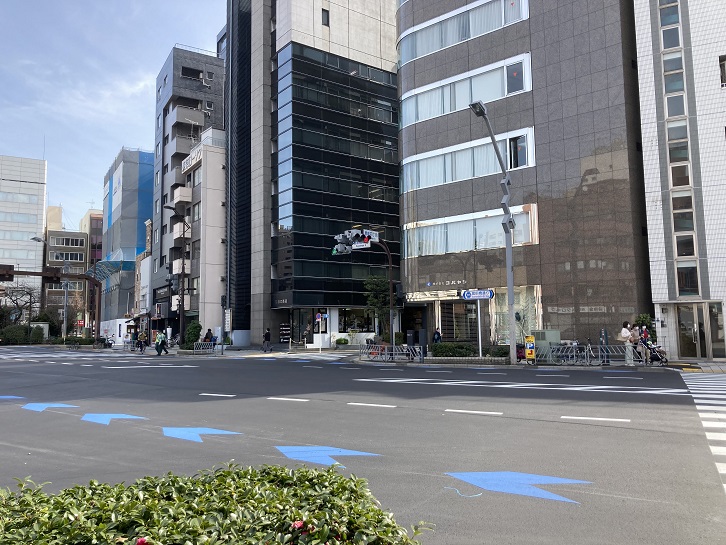
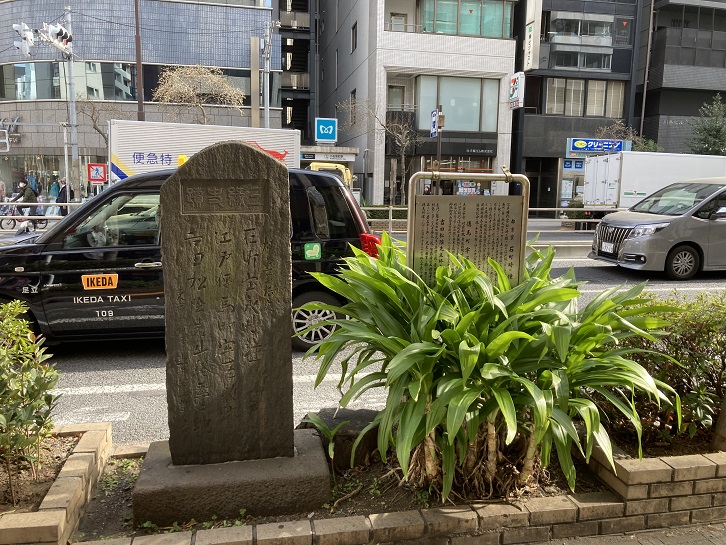
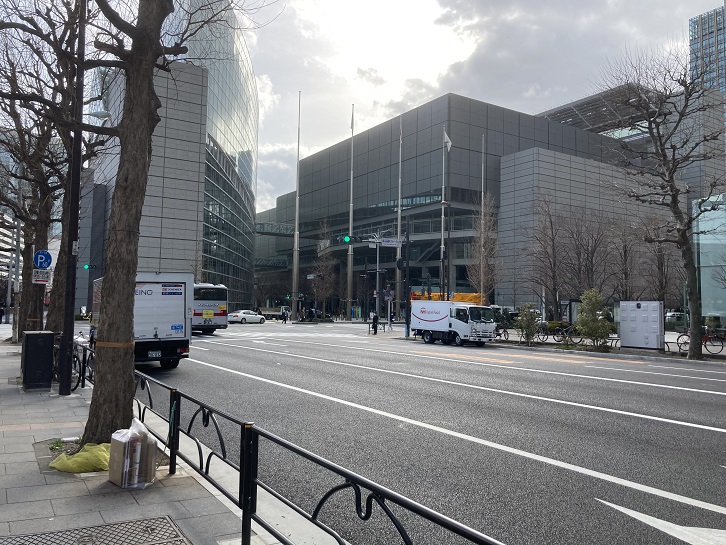
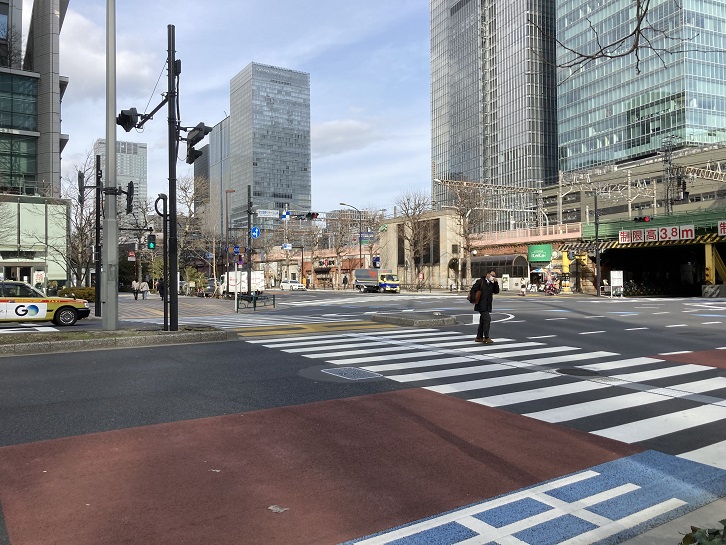
The Minowabashi Bridge was built on the point where the Otonashi River, which branched off the Shakujii River at Oji, intersected the current Nikko Kaido Road. The bridge had been about 10 m long and about 6 m wide. The Otonashi River was used as agricultural water. It passed by Nippori Station, hugged the boundary with Taito City, and crossed National Route No. 4 before reaching the San'ya-bori canal. In 1908, the Otonashi River finished its role as agricultural water and is now a closed conduit. The name of the bridge remains today as the name of the stop on the Toden Arakawa Line.
The Temple of Chokoku-ji and the Origin of Asakusa Tori no Ichi Fair
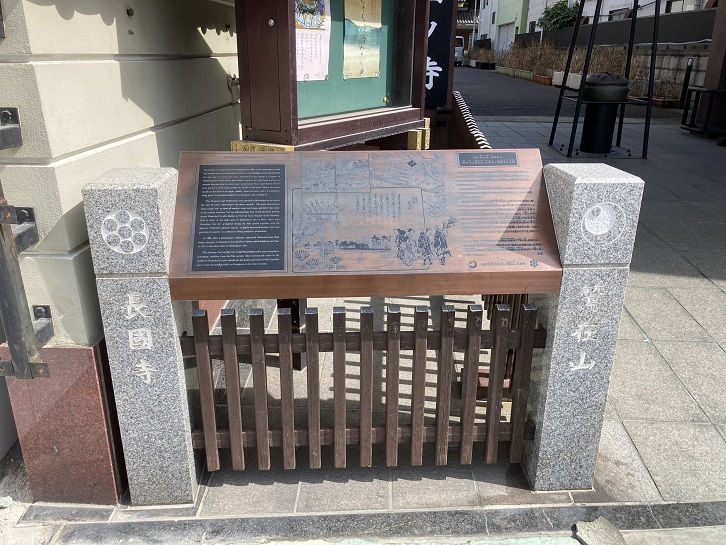
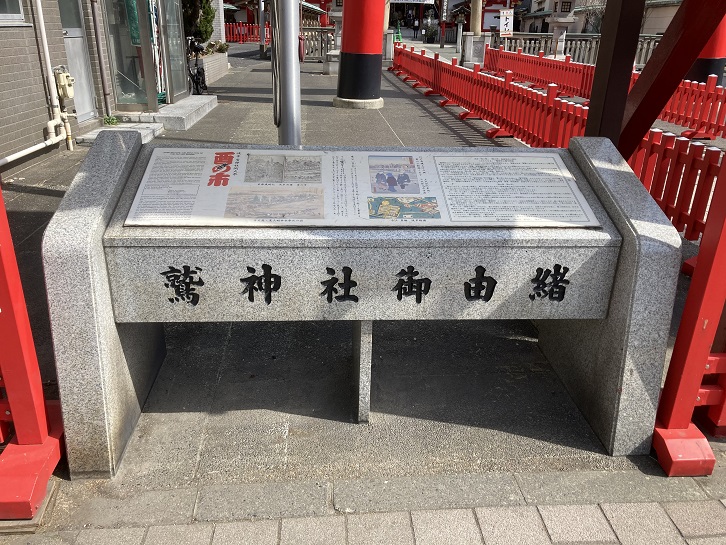
The temple of Chokoku-ji was established in 1630, in the early years of the Edo period, and it was dedicated to Nichiren, the Buddhist priest who founded the sect that is named after him. Enshrined in the temple is a statue of Washimyoken Bodhisattva, who holds a sword in his right hand and has an aureole incorporating the seven stars of the Great Bear constellation. Familiarly known as Otori-sama among the people of Edo (now Tokyo), the statue stands on the back of an eagle (washi), hence its name, and it is reputed to bring good fortune and prosperity to all people who worship it. The Washimyoken Bodhisattva was unveiled in November on the day of the Tori (Rooster), according to the lunar calendar. The event attracted so many people that an open-air market came into being, and this is the origin of the present Asakusa Tori no Ichi (Asakusa Fair of the Rooster) and the reason Chokoku-ji is also known as Tori no Tera (Temple of the Rooster). Held in front of the main gate of Chokoku-ji two or three times each November, the fair prospered during the Edo period together with the adjacent Yoshiwara pleasure quarter. A highly decorated bamboo rake was particularly popular as a charm to bring prosperity in business. In 1868, after a government ordinance separated Shintoism from Buddhism, one'part of Chokoku-ji became Otori Shrine, which holds its own Tori
no Ichi at the same time as Chokoku-ji's fair. The Asakusa Tori no Ichi fair is still flourishing today and represents a continuing tradition from the Edo period, when townspeople came to the temple of Chokoku-ji to give thanks for the health and safety of their families and to pray for good fortune and happiness in the year to come.
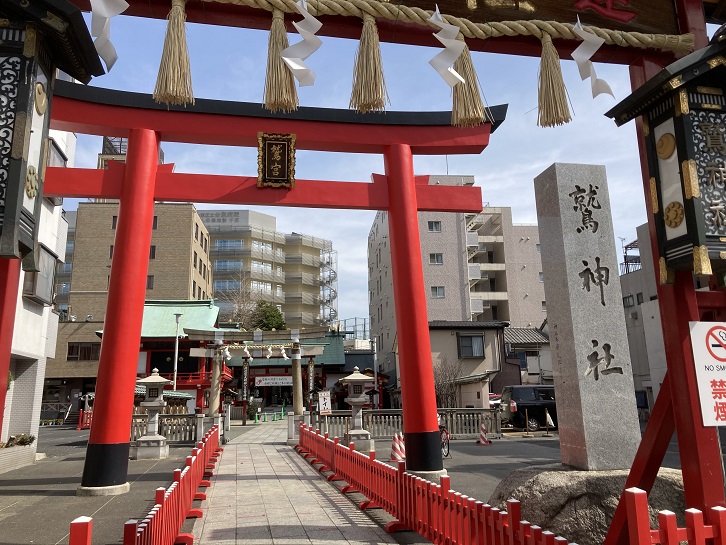
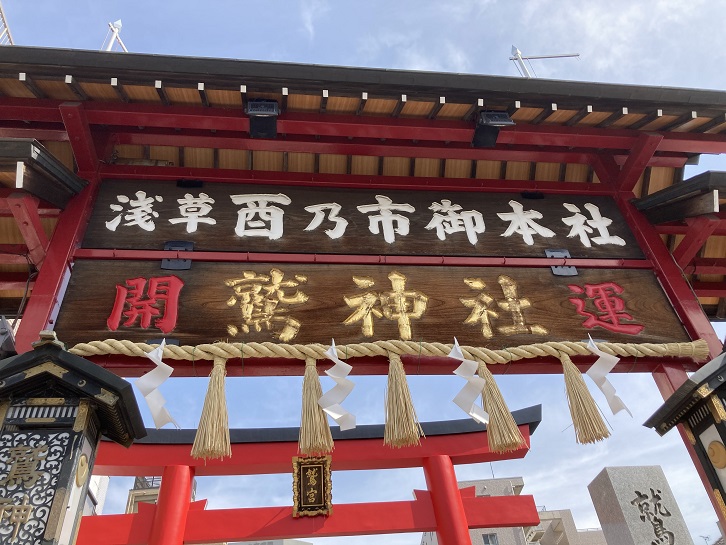
There are two gods to which the Otori Shrine is dedicated Amenohiwa-shi-no-mikoto and Yamato-takeru-no-mikoto. According to the legend of the shrine, Yamato-takeru-no-mikoto felicitated his victory on his way back from his expedition by hanging a rake on the small shrine for Amenohiwashi-no-mikoto. It occurred on the Day of the Cock in November, so that the day was subsequently chosen as the date of the festival. The Cock Fair was developed in the middle of the Edo era, as the poetical
feature foreboding the arrival of winter. There is the First Cock Fair, the
Second Cock Fair and, depending on the year, the Third Cock Fair. The year having the Third Cock Fair is said to have many fires. Originally, the Cock Fair was a fair to sell rakes for practical use as a kind of agricultural product or implement. Subsequently, a rake was said to be useful in collecting fortune and assets. Therefore, it has been regarded as the charm for bringing about commercial prosperity or luck.
"Tori-no-Ichi" Festivals of the Ohtori Shrine in Asakusa. Tokyo are held twice or thrice every November since the Edo era. That Festivals appellation is called the first Festival "Ichinotori", the second Festival "Ninotori", the third Festival "Sannotori". The origin of "Tori-no-Ichi" Festivals of the Japanese mythology of the Ameno-Hiwashino-Mikoto and the Yamato-Takeruno-Mikoto are worshiping as god, also the Ohtori Shrine commonly are called "Otori-Sama" and the Festivals on the days be bustling by worshipers, that days celebrate the Festival all day long.
And this worship is that invoke a providence, give thanks to a divine favour, both it is that pray good fortune and good news in future and keep out of harm's way.
They are borught about its when we live the daily life purely, righteously, vigorously, harmoniously. Then the 300 rake stalls in the yard of the Ohtori Shrine
sold lucky rakes bedecked with colorful symbols of good fortune, belived to bring wealth to the purchasers.
Anticipating Spring, The beginning of it all, Year-end fairs.
"Haru wo matsu, Koto no hajime ya, Tori-no-Ichi" by TAKARAI, Kikaku (Haiku)
Counted as one of Basho's ten great students, he is famous for his fresh and penetrating insights into the society of the Edo. The "Tori-no-Ichi" Festivals occurred several times, in the end of the year. It was the one time all year that the gates of the Yoshiwara Pleasure district were opened to let the public in to walk its streets. Without the "Tori-no-Ichi" market, the small merchants and farmers would not be able to pay off their annual debts. At the same time, goods bought at this market--good luck charms, food-stuffs, etc. -- constitute the first shopping in preparation for new year celebrations. While being the last big event of the year, it is also the first event in the course of new years preparations. It thus forms the bridge, both economic and psychological, between the old and new years, emphasizing the continuum of time in society from year to year.
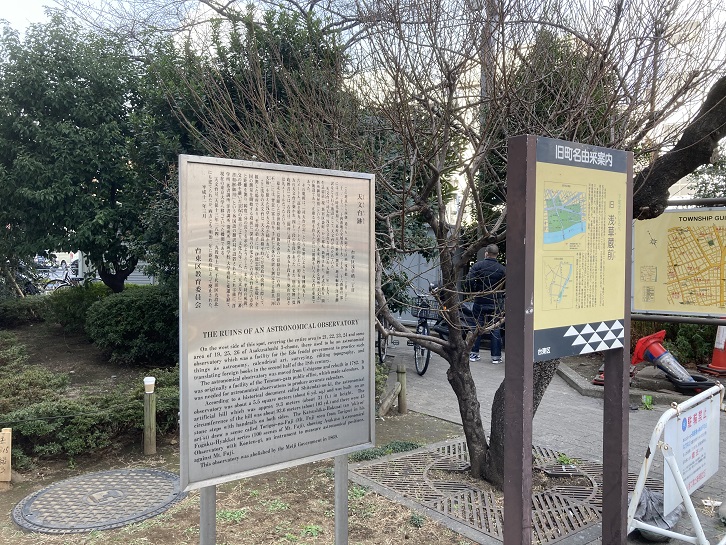
On the west side of this spot, covering the entire area in 21, 22, 23, 24 and some
area of 19, 25, 26 of Asakusabashi 3-chome, there used to be an astronomical observatory which was a facility for the Edo feudal government to practice such
things as astronomy, calendrical art, surveying, editing topography, and translating foreign books in the second half of the 18th century. The astronomical observatory was moved from Ushigome and rebuilt in 1782. It was originally a facility of the Tenmon-gata public office, which made calendars. It was needed for astronomical observations to produce accurate calendars. According to a historical document called Shitendai-no-ki, the astronomical observatory was about a 5.5 square meters (about 6 yd. sq.) and was built on an artificial hill which was approx 9.3 meters (about 31 ft.) in height. The circumference of the hill was about 93.6 meters (about 103 yd.) and there were 43 stone steps with handrails on both sides. The Katsushika-Hokusai (an 'ukivoe artist) drew a scene called Torigoe-no-Fuji (Mt. Fuji seen from Torigoe) in his Fugaku-Hyakkei series (100 scenes of Mt. Fuji), showing Asakusa Astronomical Observatory with Konten-gi, an instrument to measure astronomical positions, against Mt. Fuji. This observatory was abolished by the Meiji Government in 1869.
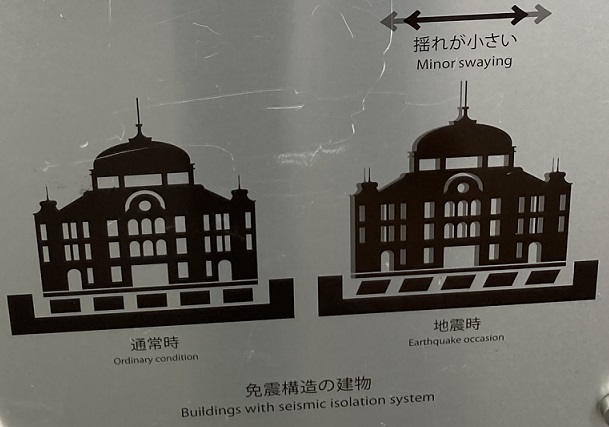
At Tokyo Station Marunouchi Building, seismic isolation design has been used to protect our customers and this building as an important cultural property from earthquakes. If an earthquake occurs, the entire building may sway slowly, so please use caution. (Maximum displacement about 30cm)
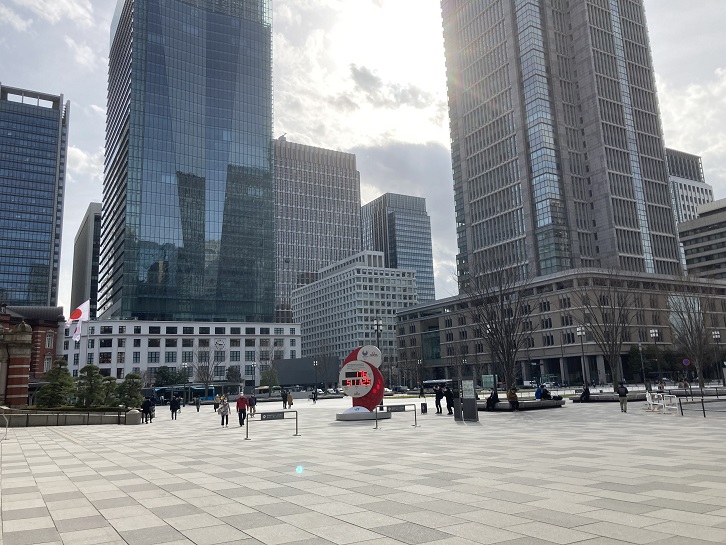
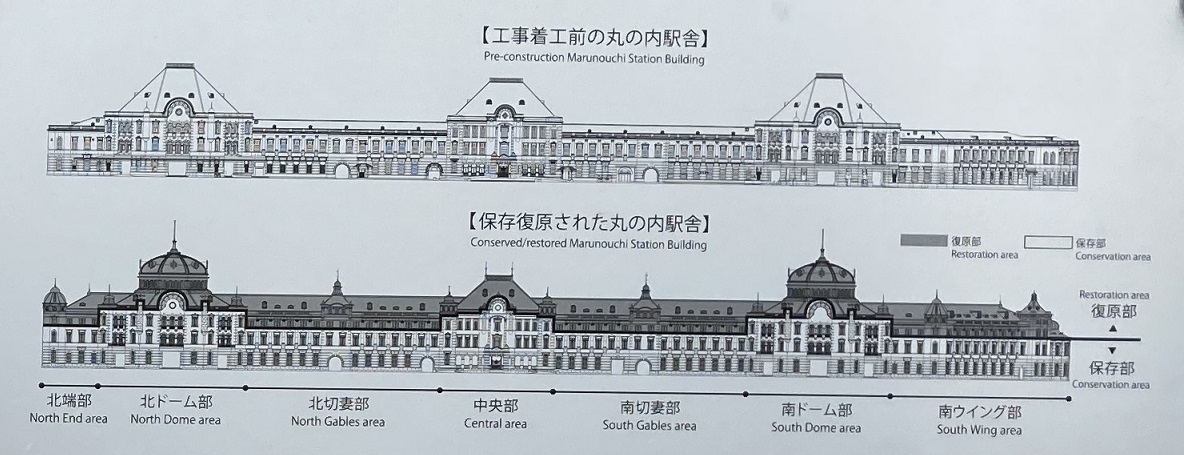
Designated as an important cultural property of Japan, the Marunouchi Station Building was restored to its original design while conserving the existing elements to the greatest extent possible as a precious historical property to be passed down to future generations.
Plaza side
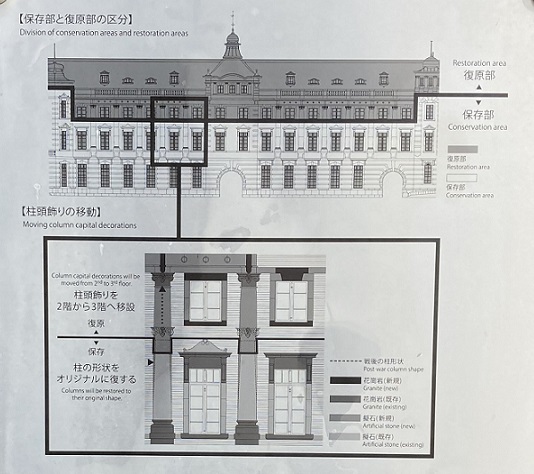
Conservation: The central area and north and south domes and other existing exterior walls and existing bricks and steel frameworks were conserved.
Restoration : The 3rd floor exterior walls were restored with decorative brick,
granite, and artificial stone after installing new framework. The roof was restored to the original design with natural slate and copper sheet.
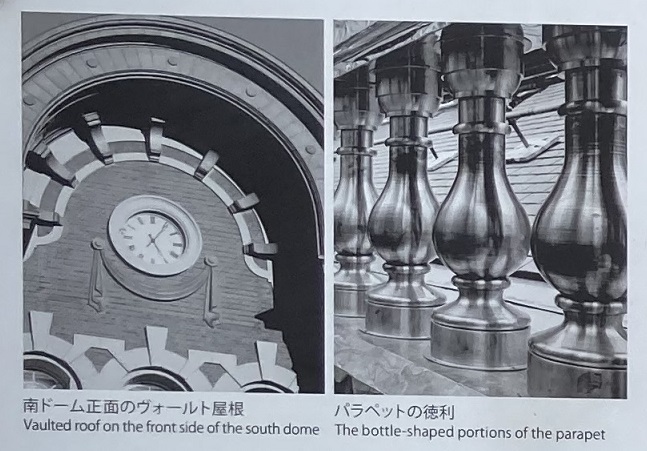
The ridges and spires on the roof are generally installed using 0.4mm copper sheets seam-jointed to a wood base. For other decorative portions, heat is applied to copper sheets, which are then hammered into shaped while cooling. The bottle-shaped portions of the parapet are being restored using a modern technology called spin forming. Aging of the components using patinas, etc. will not be conducted. Leaving the copper sheeting uncoated, we look forward
to the changes in texture as the years pass.
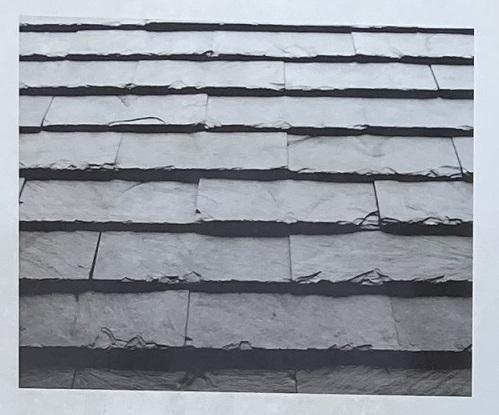
The roof is covered with a composition of natural slate and copper sheeting. From
old photographs, it was clear that the natural slate was all installed as dutchlapped roofing, which became the basis for restoration. For the central area roof, slate from Ogatsu in Miyagi Prefecture was used, which is the same slate that
was used in the original design. Additionally, in the south dome area, good quality slate from Tome that was installed during post-war repairs was removed for later use. A portion of this was processed and reused.
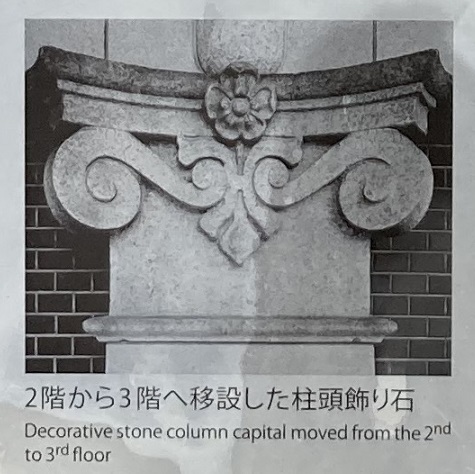
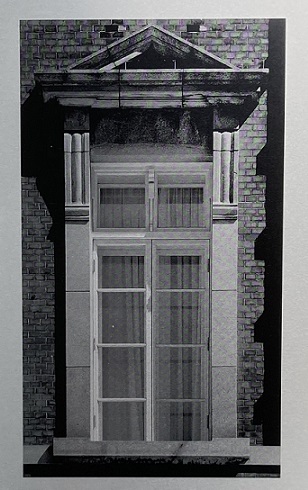
The granite used for the areas around windows and column capitals is from Inada (Ibaraki Prefecture), and that used for the spandrel walls and areas around the foyer is from Kitagishima (Okayama Prefecture). When the 3rd floor brick wall was removed during the war-damage reconstruction period (September 1945-March 1947), the column capital decorations (photograph below) were moved from the 3rd floor to the 2nd floor. However, with this restoration work, they have been returned to their original place on the 3rd floor.
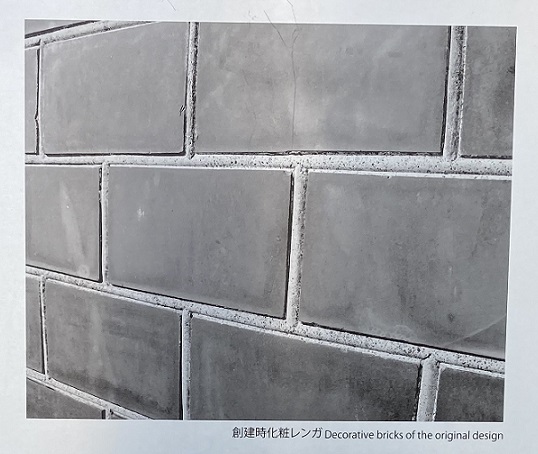
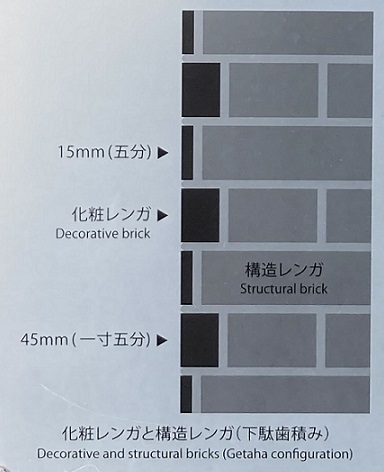
At the time of original construction, decorative bricks were
manufactured by press-forming. These bricks were exceptionally
smooth and detailed, with characteristic sharp corners. There
were two thicknesses-15mm and 45mm-made to correspond
to structural bricks in Getappa-zumi, method, in which each
layer is stacked alternately to prevent separation. The decorative
bricks restored here have been recreated with the same texture
and color as the original design. The thickness of the bricks was
consolidated at 15mm.
The exterior fittings in the original design were made of wood, but for this construction, watertight and airtight performance was considered and restorations were made with aluminum fittings. The glass thickness was kept the same as the original design at 3 mm. For the hotel guestrooms, double glazed sash windows were used to ensure soundproofing and insulation performance.