"PRONTO C''A PALA" (Ready with the pizza shovel!)
Pietro the pizzamaker and his successors - What a margherita is - Capodimonte pizzas - The authoritative opinion of the royal "taster" - Raffaele Esposito and Maria Brandi's donkey - The Naples that will never go away.
"Pronto c''a pala!" (Ready with the pizza shovel)
The prophetic phrase reverberates through the whole restaurant.
Straight from the oven to the restaurant areas on the ground floor or upstairs, wending its way up the narrow staircase. A motley crew of customers eagerly waiting in both areas: from the illustrious monocled poet to the budding young rhymist, similarly sporting a monocle; from the experienced journalist to the neophyte reporter; from the magistrate in his leisure time to the security guard in plain clothes; from the most exquisitely mannered gentleman to the commonest of corner boys. All of them keenly await the latest hot and sizzling delight from the oven. Some are dreaming of tomatoes and cheese, others garlic and olive oil, whitebait or mushrooms, or simply with port fat and cheese: the list of variations of this exquisite Neapolitan food can go on forever. Yes, that's right. Pizzas. You knew right from the very start that I was talking about pizzas.
"Pronto c''a pala" (Ready with the pizza shovel)
One after the other, the pizzas are skillfully whisked in and out of the oven at dizzying speed.
The Abruzzi kitchen boys (it is a true fact that all the kitchen boys in Naples come from the Abruzzi region) are all on their toes waiting for orders from their boss, who stands in front of them like a commander-in-chief. More and more pizzas go in and out of the oven as the restaurant fills up with customers, and the prophetic phrase rings out ever more regularly:
"Pronto c''a pala!" (Ready with the pizza shovel!)
But pizzas are not the only thing on the menu in this restaurant.
For many people a pizza is only an appetiser, to be followed by liver slices rolled in laure leaves; homemade sausages with varying amounts of pork meat accompanied de rigeur by local broccoli; sliced "Genovese"; fried mozzarella sandwiches, and so on. However, less exacting customers are more than happy with some provolone cheese served with fennel. So, right beside the wood-burning oven where the Queen of the Restaurant - the pizza - is made, the gas rings merrily burn away for the preparation of the many tasty regional dishes, which are just as much the pride and glory of our glorious beloved country as the pizza.
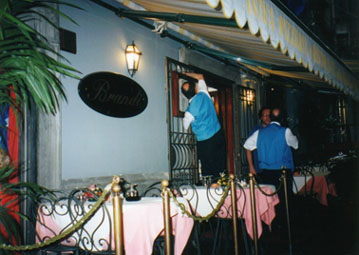
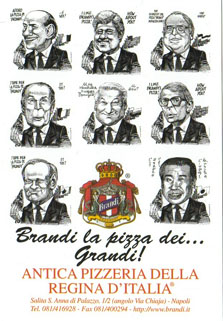
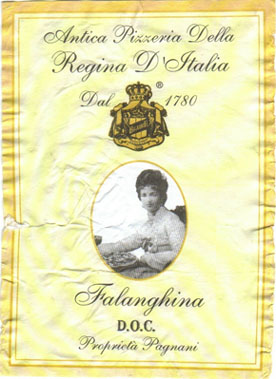
"Pietro the Pizzamaker's" pizzeria in Via Chiaia, at the corner of S. Anna di Palazzo, is one of the best known pizzerias in all of Naples.
But this pizzeria in the Chiaia area has certain aristocratic links and evokes memories of the Royal Family which constitute the glory of its centuries' old existence.
Whoever sets their eyes on the present day oeners, two fine looking elegant young men, as they closely follow the movements of their staff, readily satisfying all their customers' needs with utmost od discretion and courtesy, would never assoiate them with the famous "Pietro the Pizzamaker", standing shirtless and dishevelled, his brow bathed in sweat, behind his marble worktop as he beat his pizza dough into shape.
In actual fact, since the death in 1870 of Pietro Colicchio, the real name of "Pietro the Pizzamaker", no one called Pietro has ever worked in the restaurant, and his successors, be they called Pasquale, Vincenzo or Raffaele, have systematically been referred to as "Pietro the Pizzamaker". In all likelihood this tradition will carry on forever.
Take Pietro Colicchio's immediate successor, whose large smiling face is depicted here. He bore the plain and simple name of Raffaele Esposito. But like it or not, he found that he had to give up the name of Raffaele and be called Pietro instead, as there was no way that the restaurant's long - standing clientele would have ever started calling for "Don Rafe" instead of the more familiar "Don Pie". In this way true Neapolitans respect the traditions of their city and it is precisely for this reason that they are to be admired all the more. If only it were also true of some colleagues of mine who would appear to be Neapolitan by mistake and not by birth, as they expect to find the city in its Sunday best, bright and shiny as a new pin, dressed for any occasion.
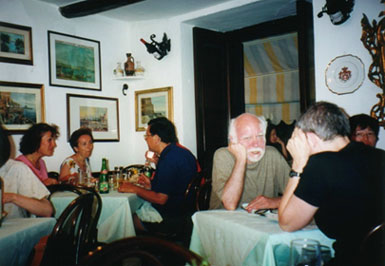
The other evening when I was in the restaurant, some nineteenth century poets were arguing with some local bards while they waited for their pizzas to cool down. I ordered one with mozzarella and tomatoes and the waiter shouted to the pizzamaker:
"A margherita for one!"
At that moment one of the Brandi brothers, attracted by the noise of the afore-mentioned poets, walked past my table. I stopped him and asked:
"Excuse me, but why is a pizza with mozzarella and tomatoes called a margherita?"
Daisies, which are called margheritas in Italian, are yellow and white, so understandably the white part is represented by the cheese in the pizza of the same name. But what is the yellow part represented by if tomatoes are red?
Mr Brandi looked down at me as if to say, "Did you just come in on the last boat?", but being a wellmannered gentleman he replied:
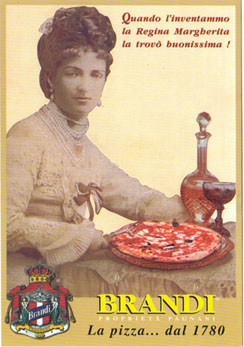
A pizza made with mozzarella and tomatoes is not called a margherita after the flower, but after the most honourable Queen of Italy.
In June of 1889 Raffaele Esposito, affectionately nicknamed "Pietro the Pizzamaker", received a visit from an employee of the royal household inviting him to the Royal Palace at Capodimonte to prepare some pizzas for its illustrious inhabitants, who were in residence in Naples at that time. Don Raffaele complied with the request and put all of his eagerness and skill into making pizza for the Royal Family.
Although the Queen tasted many of the different types of pizzas he had made, she showed a particular liking for pizza with mozzarella and tomatoes.
The outcome of this auspicious royal judgement was that pizza with mozzarella and tomatoes was christened margherita in pizzerias throughout Naples and elsewhere, in the same way that a slice of steak with an egg on top is called a Bismarck. I would also like to show you something", said Mr Brandi, taking out a piece of paper, all yellowed with age. This proved to be from His Majesty's offiial "taster", expressing the pleasure of the royal household with the excellent pizzas. Here is a copy of the curious document:
THE ROYAL HOUSEHOLD OF HIS MAJESTY
INSPECTION
MOUTH OFFICE
Capodimonte,
11 June 1889
Dear Mr Raffaele Esposito (Brandi),
I would like to officially state that the three varieties of pizza prepared by you for Her Majesty the Queen were found to be excellent.
Humblest regards,
Camillo Galli
Head of Table Services of
the Royal Household
And Mr Brandi continued:
"The Queen became particularly fond of pizza and whenever she was in Capodimonte she would send for Don Raffaele Esposito to come and make pizzas, So, Don Raffaele would set off for the Palace in a donkey and cart, with all the ingredients necessary in the back along with his beloved wife, Maria Giovanna Brandi, my aunt. No doubt you can imagine the figure they cut as they arrived at the entrance to the Park".
To tell the truth I could not imagine anything of the sort. I had other things to think about. My margherita had arrived. Well cooked base, deliciously flavoured topping and a nice thin crust all around.
Obeying the time-honoured tradition of this very dear city of mine, I took a slice and folded it in two, as if it were a book.
And to tell the truth, I could note care less if anyone were to put my photo on a postcard to show "a Neaplolitan eating with this fingers".
Michele Parise